The Promise Pile-Up: Why Good Intentions Crowd Each Other
A weekly commitment review helps you see which promises still have a clear place, so you can renew, reshape or release them with care.
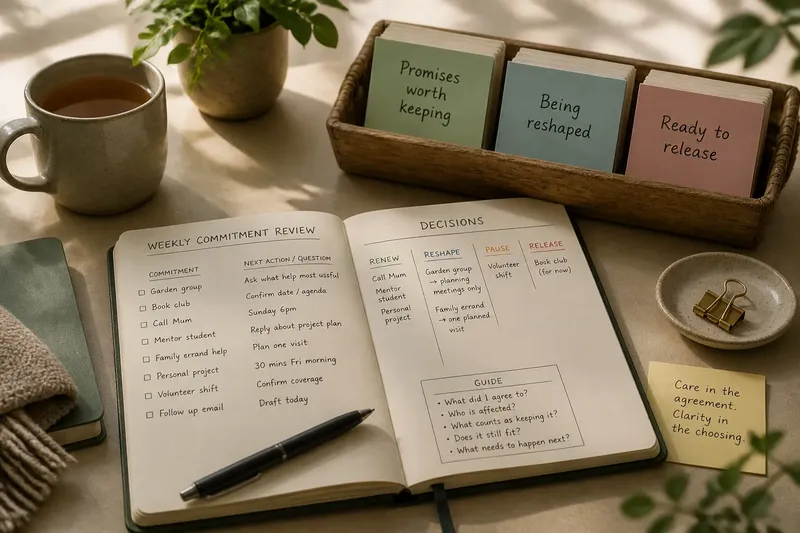
The common mistake with a promise pile-up is to treat every yes as permanent, even when the circumstances around it have changed. A weekly commitment review can help you see which promises still have a clear place, before well-meant obligations crowd out the choices you are making now.
Commitments are not only formal duties. They include the book club you agreed to organise, the regular call you offered to make, and the personal project you keep telling yourself you will return to. The difficulty is not that any one promise is necessarily wrong. It is that several can overlap until you are carrying a schedule you never deliberately chose.
Why do good intentions crowd each other?
A promise often begins in a particular moment: someone needs help, an opportunity sounds worthwhile, or you hope to become more involved. Saying yes can express care or curiosity. But the promise then persists while your available time, energy or relationships shift.
Unreviewed commitments can also hide inside vague wording. “I’ll help with the event” might mean one planning conversation or ongoing responsibility. “I’ll get back to you soon” may stay open because neither person knows what action or timeframe it entails. The vagueness makes it hard to tell whether you are fulfilling the promise, postponing it or carrying an expectation that was never clearly agreed.
Think of commitments like items on a crowded shelf. Adding one more does not remove anything already there. Something may become hard to reach, even if it still matters. A review gives each promise a visible place rather than letting the newest request decide what gets your attention.
What does a clear place for a promise mean?
A promise has a clear place when you can name what you agreed to do, who is affected, and what fulfilment looks like. You can also identify when you expect to act, or what condition must be met before you can act. The promise need not be easy, but it should be understandable enough to guide a choice.
For each commitment, ask:
- What did I actually agree to? Separate the original promise from what you now assume is expected.
- Who is relying on me? Consider the person, group or part of your own life that would be affected by a change.
- What would count as keeping it? Look for a concrete action, not a general hope to be more helpful.
- Does it still fit the life I am living? Notice changes in time, capacity, responsibilities or meaning.
- What needs to happen next? Choose a specific action, a conversation, a revised agreement or a deliberate release.
This is not a test of whether a promise is important enough. It is a way to find out whether you are still choosing it, and whether the other person understands the same commitment you do.
How can a weekly commitment review work?
Set aside a short, regular period once a week. Use a notebook, a calendar or a notes app; choose the tool where you can see both your promises and upcoming demands. The review is not a productivity contest. Its purpose is to notice drift while there is still room for an honest conversation.
At the start of the week, what should I list?
Write down active promises, including informal ones you have been carrying mentally. Include recurring tasks, volunteered roles, personal intentions and replies you owe. Keep each item brief, then add the next action or the question you need to clarify.
Midweek, what should I revisit?
Check only for changes that affect a promise: a new request, a missed conversation or a shift in your availability. If something is unclear, ask the other person what they understood rather than silently expanding or shrinking the agreement. This keeps a small ambiguity from becoming a larger expectation.
At the end of the week, what deserves a decision?
Look for commitments that have no next action, keep moving to a later date or no longer seem connected to what you intend to give. Decide whether to renew, reshape, pause or release each one. Record the decision so the same promise does not return as an unexamined item next week.
What should I say when I need to change a promise?
Be direct about what you agreed to, what has changed, and what you can now offer. For example: “I agreed to coordinate the next meeting, but I can’t continue organising the series. I can hand over the notes this week; could someone else take over after that?” A clear limit gives the other person something they can respond to.
How do you decide whether to renew, reshape or release?
Renew a commitment when it still has a clear purpose and you are willing to make room for the action it requires. Renewal does not have to mean doing more. It can mean keeping the same agreement and giving it a definite place in your week.
Reshape it when the underlying care or intention remains, but the current form no longer fits. A person who promised to help a relative with errands, for instance, might agree to make one planned visit instead of being on call for any request. The new arrangement should be specific enough for both people to understand.
Release a commitment when you cannot identify a reason to continue it, or when continuing would depend on pretending you have capacity you do not have. If another person is relying on you, tell them promptly and, where appropriate, offer a reasonable handover. An honest ending is more useful than a quiet disappearance.
Imagine you agreed to join a neighbourhood garden group during a calmer stretch, then took on a family responsibility that changes your available evenings. In your weekly review, you notice that attending meetings and tending a shared plot are two separate expectations. You ask the group what help is most useful, then agree to attend planning discussions but step back from regular plot duties. The observable result is a clearer agreement: other members know what they can count on, and you no longer carry an undefined promise to do both.
What makes a commitment review considerate?
A review should not turn other people into entries to be cleared. Some promises matter precisely because someone is counting on you. That is a reason to communicate, not a reason to keep every agreement unchanged regardless of circumstances.
When a change affects someone else, speak before they have to discover it through your absence. State the limit without blaming them, and avoid offering a replacement you already suspect you cannot meet. If you need time to decide, say when you will respond. A modest, dependable answer is clearer than an enthusiastic yes that leaves the other person guessing.
For personal commitments, use the same care without treating every abandoned intention as a failure. You may decide that a project no longer belongs in this season of life. Name that decision plainly, so it stops occupying attention as though it were still an active obligation. If circumstances change later, you can choose it again rather than assuming it was waiting unfinished.
How can the review stay useful as life changes?
Keep the routine light enough to repeat. A long inventory can become another task to avoid; a short list with honest decisions is enough. If a promise has no clear place, put the needed conversation or decision on the calendar rather than adding a vague note to “think about it”.
Use the same review when a major change disrupts the usual rhythm, such as a new caring responsibility or a move. Do not wait for the next scheduled check-in if someone needs an answer sooner. The weekly habit supports timely choices; it does not replace them.
A weekly commitment review is most useful when it helps you see the difference between a promise you still choose and one you have simply been carrying forward. Give each agreement a clear next action, a revised shape or an honest ending. That small act of naming makes room for commitments that genuinely belong in the life you are living now.