Before the Bucket List: A Brief History of Personal Aims
Personal aims can mean more than bucket-list experiences. Learn how to connect a specific wish with the values and relationships that give it meaning.
The common mistake is to treat a list of desired experiences as a complete account of what makes a life worthwhile. A bucket list can preserve vivid wishes, but it can also narrow personal aims to things that can be named, scheduled and crossed off. The history of personal aims offers a useful distinction: people have long reflected on how to live, but the surviving writings do not all frame that question as a collection of experiences.
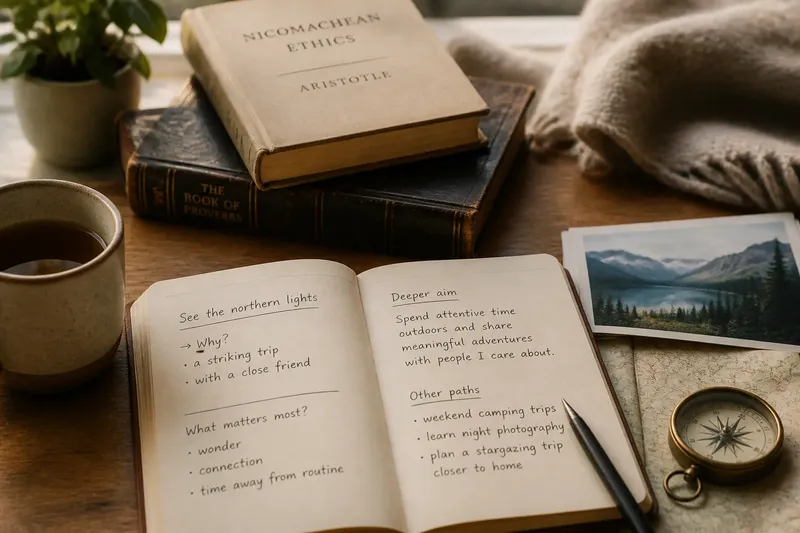
For example, Aristotle’s Nicomachean Ethics discusses virtue and human flourishing, while the biblical Book of Proverbs includes guidance about conduct and relationships. These works come from distinct settings and should not stand for every person or tradition. They do, however, show that some influential reflections on a worthwhile life focused on conduct, character and obligations rather than a catalogue of events.
What does a personal aim include?
A personal aim is a direction a person considers worth pursuing. It may point towards an outcome, such as learning a language, or towards a way of living, such as being attentive to friends. An aim can last for a season or shape a whole life. It need not be written down to matter.
A list of experiences is a narrower tool. It gathers events someone hopes to have: walking a long-distance path, seeing a particular landscape or attending a performance. These wishes can carry real meaning, but they describe occasions more readily than the habits and relationships around them.
Think of a kitchen drawer. A list of experiences is like a set of recipe cards: each suggests something to make. Reflection on a life well lived asks what sort of meal, and what sort of table, those recipes belong to. The second question does not make the first less enjoyable; it supplies a larger context.
How did some older reflections frame a life well lived?
There was no single older tradition of personal aims. Societies, periods and individuals differed, and access to leisure, education and choice was uneven. Some philosophical and religious writings considered character, duties and a person’s place in a community. Those texts reveal particular ideals, not a complete picture of how everyone lived or thought.
In Aristotle’s ethical writing, virtues such as courage and justice are considered in relation to how a person lives, rather than as isolated experiences to acquire. In the Book of Proverbs, many passages address conduct towards other people and the responsibilities of daily life. The works are different in purpose and context, but both offer examples of reflection that asks what actions and habits make a life good.
Other writing, including the Stoic philosopher Seneca’s letters, turns attention to conduct, limits and the use of time. Such reflection can involve examining how one has responded to difficulty or whether one’s actions match one’s principles. It need not centre on a grand achievement; it may focus on repeated choices.
These ideals had limits and could be used to reinforce social expectations. Duties might be shaped by family, class, gender or religious authority, leaving people little room to choose a personal course. The past should not be romanticised as a time when everyone had freedom or leisure for inward reflection. Its value here is narrower: it shows that personal aims can be understood as more than destinations.
Why did some personal aims become framed as experiences?
There is no single historical cause that explains the popularity of experience lists. In some settings, changes in work, mobility and leisure gave people more opportunities to choose activities and travel. At the same time, diaries, travel writing, guidebooks and later popular media offered ways to describe and share particular outings. These examples help explain how experiences could be presented as distinct possibilities; they do not establish one universal shift in how people understood a good life.
A list gives such wishes a neat form: each can be pictured, pursued and marked complete. That form suits some aims particularly well. If the wish is to hear a favourite musician perform, a completed event may be exactly the point. But friendship, care, craft and civic involvement are sustained through recurring actions, not secured by one memorable occasion.
Modern lists are not necessarily shallow, just as older forms of reflection are not automatically profound. A list may express curiosity, courage or affection for the natural world. The useful question is whether an item stands alone or serves a larger intention. Visiting a relative’s hometown, for example, may be an experience; it may also express a wish to understand family history or strengthen a relationship.
What can a list reveal that reflection might miss?
Lists make desire concrete. A broad wish such as “live more fully” can be hard to act on, while “take a train through the mountains” gives the imagination something specific to hold. Naming an experience may expose a neglected appetite for novelty, solitude, movement or shared adventure.
They can also help people notice the shape of a life as it changes. A wish written years ago may no longer fit. Removing it need not mean failure; it can show that circumstances or understanding have shifted. The list is then a record of changing desire, not a contract with an earlier self.
The limitation appears when completion is mistaken for significance. A tick confirms that an event happened; it does not tell someone what the event meant, what it changed, or whether it belongs in the life they want to lead. Reflection asks those further questions without requiring every answer to become another task.
How can you connect an experience to a larger aim?
Start with one item you genuinely want, rather than adding wishes to make a list look impressive. Ask what draws you to it. Is it the place, the challenge, the company, the skill or the chance to be away from routine? The answer may point to a quality or relationship that matters beyond the event.
Then ask what would remain valuable if the specific experience became impossible. If the wish is to walk a famous trail, perhaps the deeper aim is to spend attentive time outdoors, build confidence in unfamiliar places or share a demanding journey with someone. Those alternatives do not replace the original wish; they show that its meaning may have more than one route.
Say you have written down “see the northern lights” because you want a striking trip with a close friend. Suppose, in this invented situation, travel becomes impractical and the two of you still want shared discovery. You identify the underlying aims as companionship and time outdoors, then choose a nearby overnight walk. The observable result is a plan that preserves those aims, though it does not reproduce the spectacle; if the walk does not suit either of you, you can instead choose a local activity together or leave the wish unresolved.
Keep the distinction clear in your notes. Record the experience as a possible event, and separately name what you hope it will express. That separation makes it easier to revise the event without discarding the intention. It also prevents every underlying value from being turned into a new project.
What questions help distinguish a wish from a direction?
Is a bucket list the same as a set of life goals?
Not quite. A bucket list usually names experiences someone hopes to have, while life goals may include ongoing roles, practices or outcomes. The two can overlap, but the list alone does not explain what gives each item meaning.
Can an experience still matter if it changes nothing?
Yes. Pleasure, beauty, play and wonder can be worthwhile without producing a lasting transformation. Reflection is useful not because every outing needs a lesson, but because it can help distinguish freely enjoyed experience from an obligation to keep collecting highlights.
Should I keep an old aim after my circumstances change?
Keep it only if it still speaks to you, not because a past version of you wrote it down. You can adapt the route, postpone it or let it go; the decision itself can clarify what you value now.
How often should I review personal aims?
There is no required schedule. A review may be useful when a season of life changes, when a list begins to feel burdensome or when an item no longer stirs genuine interest.
What can this history offer in a changing season?
The history of personal aims does not prescribe a better list. It broadens the question behind one: not only “What would I like to experience?” but also “What kind of life would make room for this, and why does it matter to me?” Both questions can sit together without forcing every pleasure into duty or every value into a target.
When an aim becomes difficult to pursue, look for the distinction between its form and its meaning. The event may depend on money, health, time or other people; the underlying direction may have a different expression. This is not a demand to find a substitute for every lost possibility. Sometimes the honest response is grief, followed later by a new wish.
A bucket list can hold memorable possibilities. Reflection can help you understand the life those possibilities belong to. Keep the list light enough to revise, and let its entries point beyond themselves when they do. That way, a completed experience can be enjoyed for what it was, while the larger direction remains available after the tick mark.